In The Coaching Process we took a high level overview of the coaching process, introducing the “What? - So What? - Now What?” framework. In the next three issues we’ll be looking at each phase of the process in more detail, starting this week with “What?” And remember, for the coaching conversation to be successful it is important to first take the time to begin together.
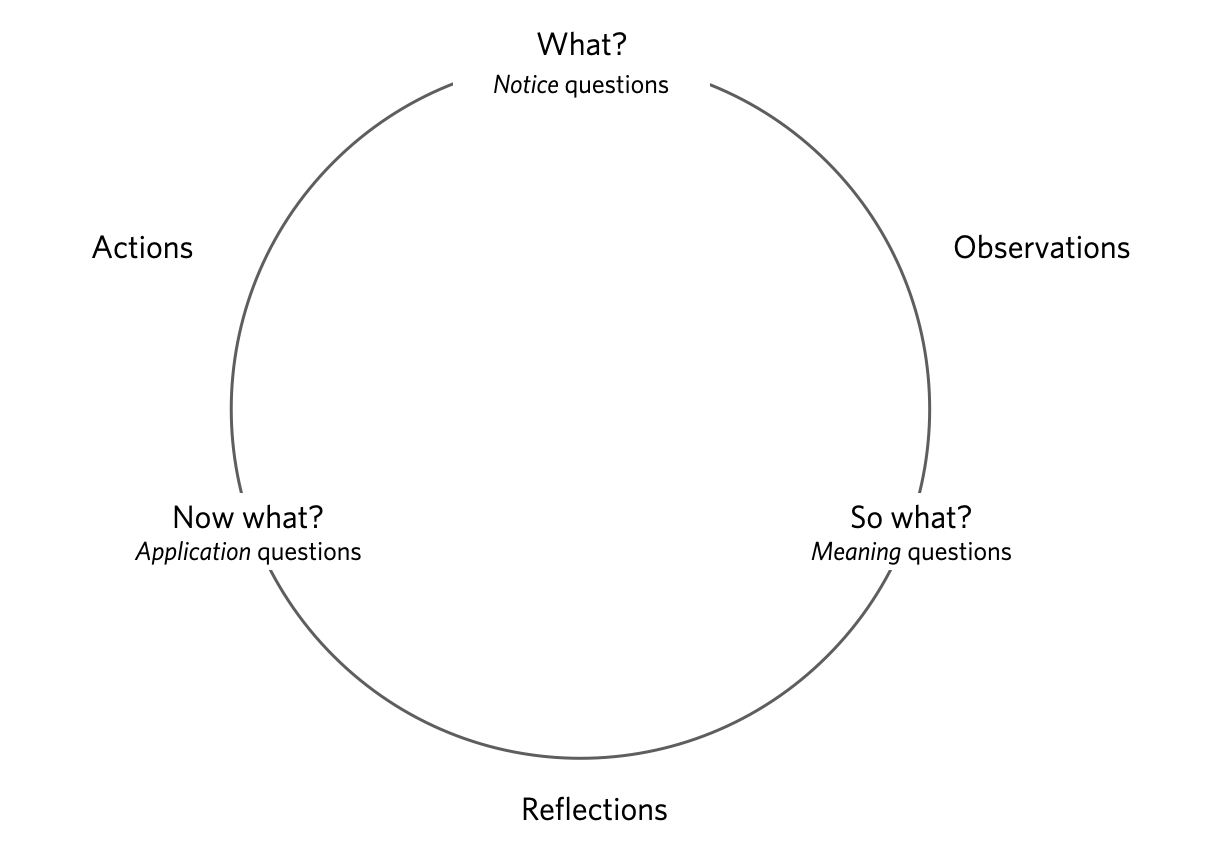 Process Framework for Enabling Action, via Dorothy Strachan
What? Aka Noticing and Exploring
The majority of work you do in a coaching conversation will be in the “What?” phase of the cycle, which is often referred to as the exploration phase. This is where you work with another person to facilitate a deeper awareness of the issue they have brought to the coaching conversation. To increase their ability to see beyond the edges of their current interpretation, to uncover habitual patterns of thinking and doing that are contributing to what is happening, and to connect with an inner knowing and resourcefulness that enables a different way of relating to the issue at hand.
Increasing awareness is a unique aspect of coaching conversations and one of the reasons they can be so powerful. In normal conversations we are quick to identify problems and leap to action, behavior that is frequently rewarded in organizational settings. But this quickness can reinforce biases and keep us running the same old fixes over and over, leading us to wonder why we keep getting the same results and nothing seems to change.
To get different results you need new ways of thinking and seeing, which is what awareness building is all about—facilitating a deeper understanding that creates a wider range of possibility, leading to new ways of responding and taking action. An important distinction to be aware of is that coaching isn't about problems, it's about solutions. Problems are about what is wrong, whereas solutions are about what could be better.
Stop Helping
Now, I'm going to say something really important and counterintuitive: in your role as coach the best way to help the other person is to not help. I actually assign this as homework in Week 1 of the Leader as Coach program and people meet the assignment with a bit of incredulity and suspicion, wondering “Isn’t that what we are supposed to do as managers? To help our team, to get them unstuck, to run interference, and make sure they can do what we hired them to do?” Yes, and… if you truly want to support the development and growth of another person, hold them with unconditional positive regard and trust that with some space to think and open questions to facilitate that thinking, they will come up with their own insights, answers, and next steps.
I always refer to Rachel Remen when discussing the challenge with helping because she says it so clearly and beautifully:
Helping is based on inequality, it’s not a relationship between equals. When you help, you use your own strength to help someone with less strength. It’s a one up, one down relationship, and people feel this inequality. When we help, we may inadvertently take away more than we give, diminishing the person's sense of self-worth and self-esteem.
So instead of helping, think of serving—in the role of coach you work in service of increasing awareness, insights, possibility, and action in another person, serving their own inner wisdom and knowing. This also requires that you hold back on sharing your experience, opinions, and advice. The shift from helping to serving is often an “ah-ha” moment for leaders who are learning to coach. They realize how much effort they have been putting in to conversations and how exhausting it is to hold more than 100% of the responsibility. Leaning back and taking a serving role, the conversation becomes more equal. Leaders often report that by doing less in these conversations they have more energy and get feedback that the conversation was powerful, facilitating new insights, learnings, and possibilities for the person being coached.
Coach the Person, Not the Issue
Another critical aspect of exploring is to remember that you are coaching the person, not the issue. This is a common maxim in many coaching programs that turns the typical management approach on its head. We are used to stepping into a work conversation and focusing on an issue, working with our direct report or colleague to figure out the best path forward. In coaching conversations the issue is secondary to the person you are working with. As a coach, you are a facilitator of their learning, supporting them to think about the issue in new ways. To do this, your questions need to invoke reflection, awareness, and new understanding for them. If you catch yourself asking questions related to the issue (e.g. going down a path of collecting more information so you can understand the issue better) stop yourself and refocus on the person in front of you.
A side note here: once you make this adjustment, you’ll find that you can often have impactful coaching conversations in a relatively short amount of time. This is because you aren’t wasting time getting all the details about what is going on, who said what, and what happened when. It really doesn’t matter. What does matter is how the person you are coaching is thinking about the issue and what deeper insights are available through open and honest questions.
The Practice
The practice this week is short and sweet, combining several of the skills and approaches we have covered in previous issues. In your conversations over the new couple of weeks, remember practice the following:
- Work to increase awareness (see The Loop of Awareness, specifically the section on “Noticing” questions).
- Stop helping.
- Get curious.
- Focus on facilitating learning.
- Coach the person, not the issue.
- Practice asking open and honest questions.
Keep a journal where you can note what you are learning and the impact the conversations are having on yourself, your team, and the wider organization.
Quotes I ❤️
I define coaching broadly as that part of a relationship in which one person is primarily dedicated to serving the long-term development of competence, self-generation, and aliveness in the other. Coaching is a central and critically important activity for any leader in any organization who sees himself or herself as working with and through others.
— Doug Silsbee, Presence-Based Coaching
This essay, written by Andrea Mignolo, was first published on November 26th, 2023 on Words Make Worlds.