I work with a lot of accomplished, caring, and successful leaders in my role as an executive coach. From the outside they seem confident, dedicated, and hard-working. On the inside, however, many are living with a loud and vicious inner critic that meticulously chronicles all the ways they come up short.
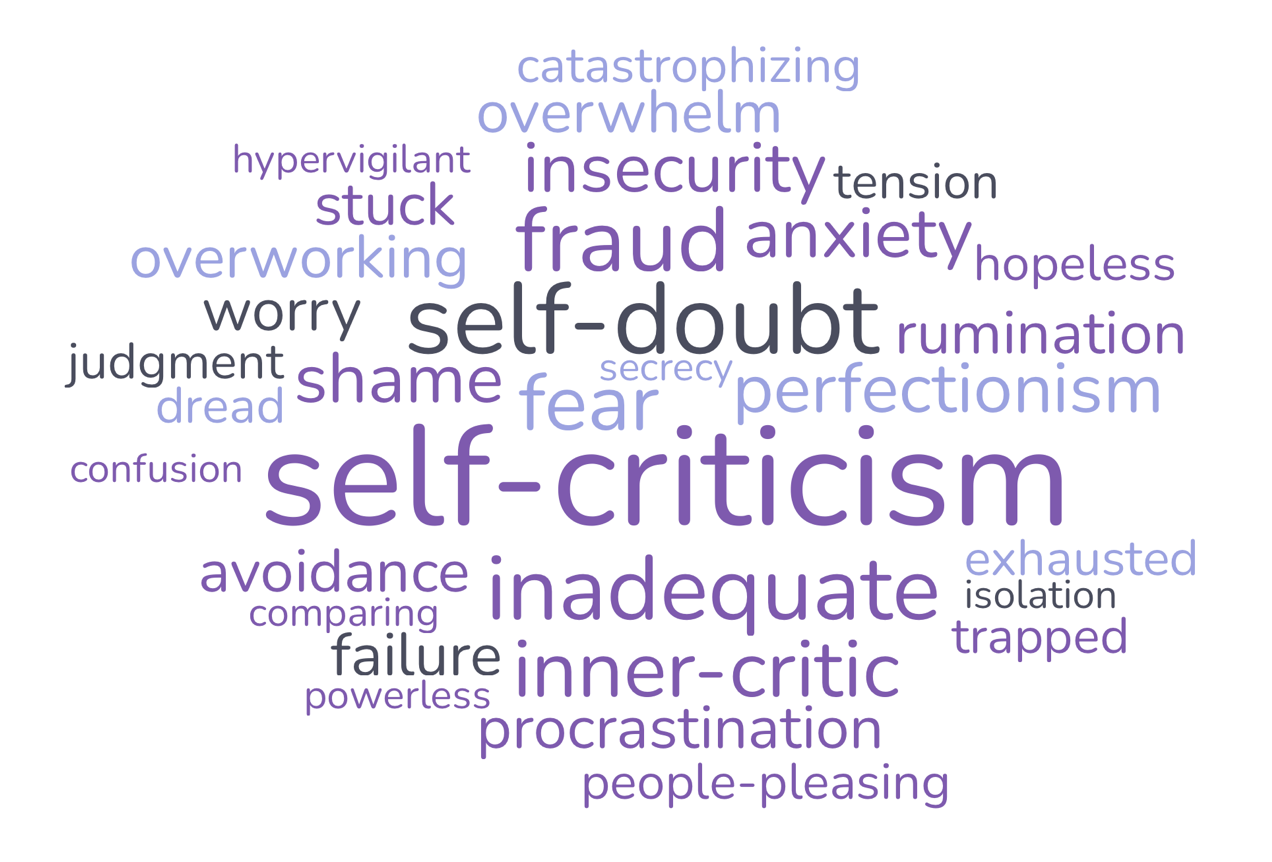
To add insult to injury, as the perceived failures and shortcomings are called out, a fear starts to creep in that others will find out what the inner critic already knows. So not only do these leaders feel bad about themselves, they also live with the terror that others will uncover their secret.
It is exhausting to live like this. It takes a lot of energy to keep constellations of judgement and fear going. Yet a surprising number of leaders believe that intense self-criticism is the reason for their success. That without negative self-talk they wouldn’t be where they are today.
I do want to caveat this by saying there is a difference between healthy self-awareness and destructive self-criticism. It is absolutely critical that a leader has the capacity to reflect on their performance, learn from mistakes, and grow. Healthy self-awareness is grounded in reality with a clear sight to the future.
Destructive self-criticism, which is what I am talking about here, is different. It is not grounded in reality, holds a distorted view of the future, and obsesses about the past. Destructive self-criticism makes it hard to learn from experience, disrupts the ability to creatively problem-solve, and blocks growth.
The problem with judgement
When we judge ourselves, we are both the attacker and the attacked. The body responds accordingly, activating the autonomic nervous system into what it considers an appropriate response—fight, flight, freeze, appease. When self-criticism is the inciting event, protective responses tend to fall into either overwork or avoidance:
- Fight looks like perfectionism. People push harder, try to control everything, and work constantly in an effort to quiet the voice
- Flight can take the form of procrastination, a choice to withdraw or avoid something—a difficult conversation, a challenging situation, anything where they might be exposed
- Freeze tends to show up as paralysis around work where leaders shut down, can’t make a decision or take a next step, and possibly experience numbness as well
- And appease is the age-old strategy of people pleasing. Taking on more work, accommodating everyone, and losing any healthy boundaries that may have been in place in an effort to hide through overwork
If the body stays in one of these responses long enough, which is often the case when intense self-criticism is involved, it starts to contract with tension, disconnecting us from our ability to feel our emotional and physical state.
With a tense body and dysregulated nervous system, thoughts spiral and become even more distorted. We become trapped in our mind as it obsessively reconstructs an event from the past or catastrophizes about the future.
To work with the inner critic, the body is essential. Yet the inner critic is the very thing that disconnects us from this vital resource! The body brings us essential information about what we are feeling, the state of our nervous system, and any emotions that are present.
When we feel ourselves in this way, the mind quiets down. This is largely because thinking about ourselves and feeling ourselves are antagonistic—when one mode is active, the other fades to the background.
This is important because while the mind can time travel to the past and future, the body is always right here in the present moment. So feeling the body means we have to be right here, right now. We can’t be anywhere else, including wherever the inner critic wants to take us.
This is why exercises that support connecting with the body and feeling ourselves (breathing techniques, gentle movement, mindfulness) can be so grounding and often bring a sense of relief when the inner critic gets a little too rowdy.
Many leaders go years, if not decades, using desensitization and the fear-response to propel them forward. But at some point the scare-tactics-as-motivation stop working as well, and the cost of self-criticism becomes more apparent. Exhaustion, poor health, fraying relationships, loss of confidence, and lack of effectiveness can all show up as warning signs that something needs to change.
Self-criticism is adaptive
Self-criticism runs deep. It is thought to be adaptive—the inner critic and its constellation of friends emerged to protect us early in life from psychological or physical threats (be good so you don’t get punished, make sure your room is immaculate so you don’t get hit with a wooden spoon). People will often recognize that some of the things the inner critic says are exactly what a care giver said to them when they were little.
And because it has been around so long it can be hard to work with—we can’t just tell the inner critic to shut up or go away (this is a tactic some recommend, but I find the critic just gets louder when you do this). But we can utilize the very same systems that created the downward spiral of the inner critic to imprint new behaviors grounded in our own competence.
From downward spirals to upward spirals
Research has shown that the difference between people that get dysregulated by self-criticism and those that find more constructive paths forward isn’t that the latter don’t experience self-doubt or anxiety, but that they interpret it differently.
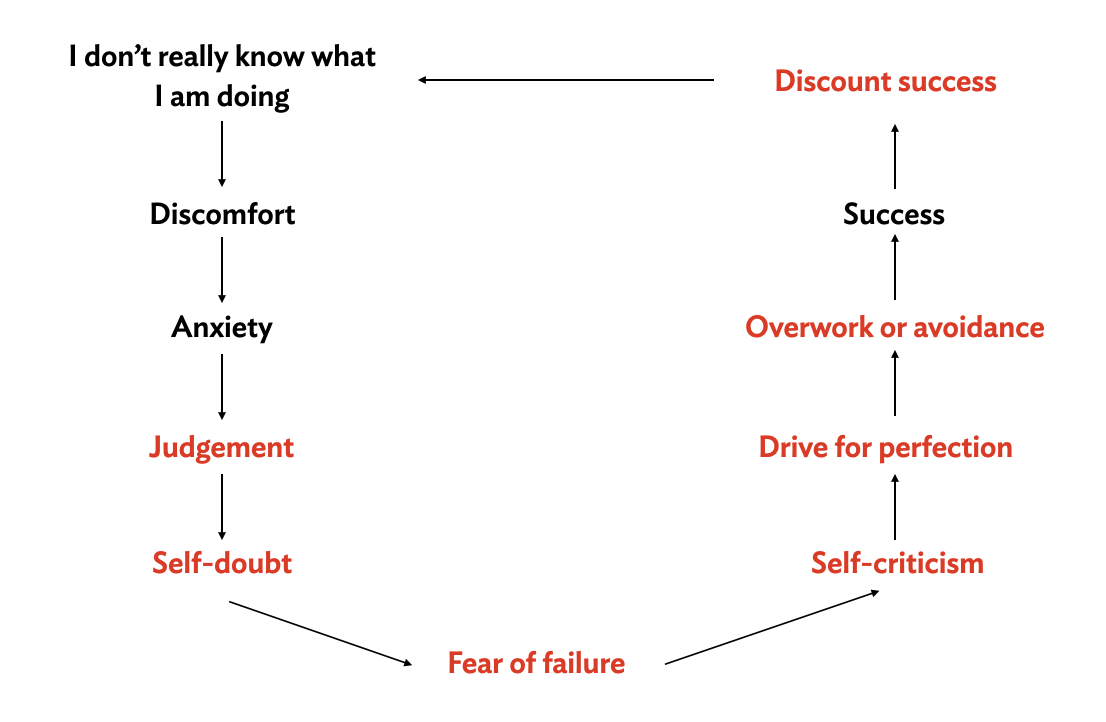 The downward spiral of judgement and self-criticism. Adapted from The Imposter Cure.
This is the downward spiral of self-criticism and judgement, where the discomfort and anxiety that comes from feeling like we don’t know what we are doing leads to judgement, self doubt, and a fear of failure that invokes self-criticism covered by perfectionism and overwork (or possibly procrastination) such that even when success is achieved it is discounted and the loop spirals down again.
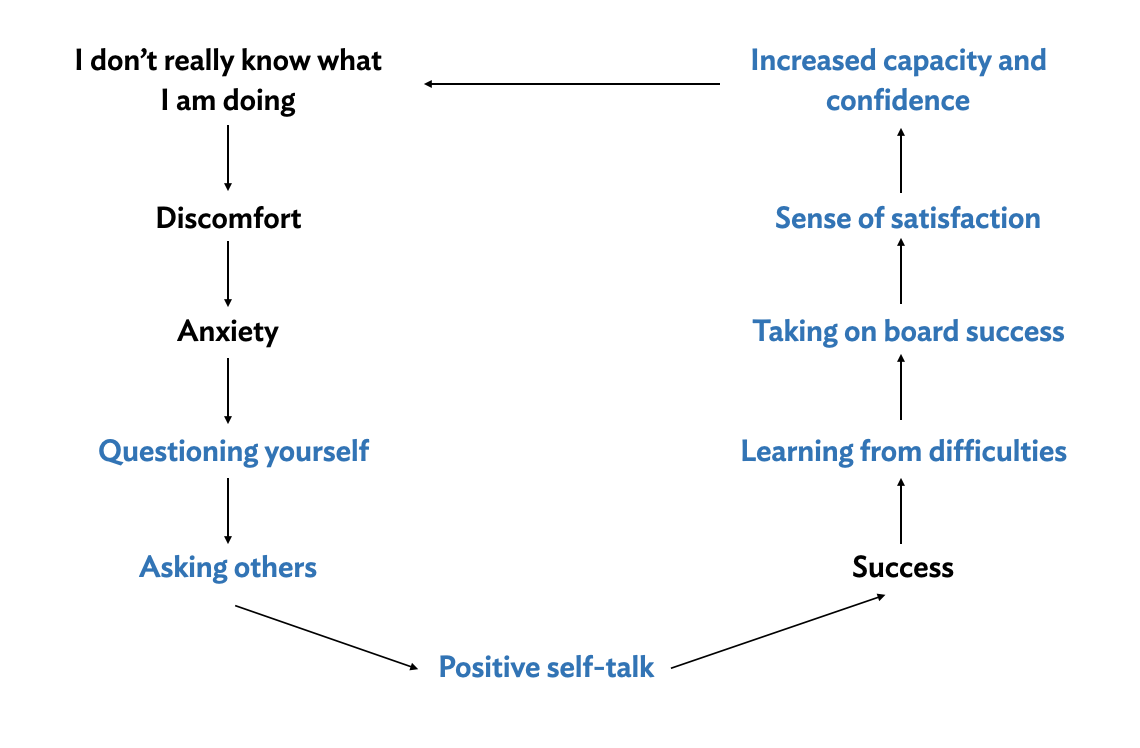 The upward spiral of healthy self-awareness. Adapted from The Imposter Cure.
Versus the same sense of not knowing what we are doing that brings up discomfort and anxiety but instead of self-judgment, healthy questioning rooted in self-awareness takes its place, followed by reaching out to others and asking for their thoughts and perspectives along with some positive self-talk.
When success happens, people in this loop can learn from the difficulties they faced, take in their success, and the sense of satisfaction they experience increases their capacity and confidence for the next time they face something challenging.
Anxiety and discomfort are normal. They ask us to bring awareness and reflection to something that feels important and challenging, to learn what we need to know to get better and experience success while also leaning on the skills and strengths we already have, as well as the support of others.
The power of self-compassion
Judgement and criticism isolate us, trap us in our own distorted thoughts until panic drives us forward. When this happens, the best antidote is self-compassion.
According to Dr. Kristin Neff’s work, there are three elements to self-compassion that can be practiced on a regular basis:
- Mindfulness: Simply recognize and name when you’re stressed or struggling without being judgmental or overreacting. Notice what’s happening without making it worse.
- Self-kindness: Being supportive, gentle, and understanding with yourself when you’re having a hard time. Talk to yourself the way you’d talk to a colleague or patient you care about.
- Common humanity: Remembering that everyone makes mistakes and experiences difficulties. Struggle is part of being human, not evidence that something is wrong with you.
Pausing to be kind to yourself, even if just for a few minutes at a time, is the practice of letting go, being present, and seeing the inner critic experience for what it is—a moment of suffering. The harsh and hurtful words we say to ourselves are intended to prevent the misplaced fear of an even greater suffering: being “found out”.
You got this
What is really to be “found out” is how wonderful and human you are. The immense capacity you have to learn, grow, and serve in ways that are uniquely yours.
You got to where you are not because of the inner-critic, but because you are a creative, caring, ambitious, and thoughtful human who does amazing things, sometimes makes mistakes, and learns from every experience.
Let yourself relax into this understanding, supported by the body, and feel your way into your true leadership capacity.
You are amazing.