Like all of you, I’ve been thinking a lot about the role of leadership in a world where AI transforms the way we work. Or rather, thinking about how to think about leadership in a business environment that is increasingly integrating AI into organizational processes.
The urgency and pressure to adopt AI is intense. I’m seeing a lot of organizations try and approach AI adoption through usage leaderboards, which can frustrate folks who prefer a more coherent approach.
It can also create what some refer to as “the frozen middle”, the layer of management caught between C-Suite demands for AI integration and the rapid adoption of AI tools by individual contributors.
Squeezed between executive ambition and individual experimentation, many in management roles are feeling an existential fear and wondering if their work is now irrelevant.
If this sounds like you, take a deep breath with me. In through the nose and all the way down to the belly. Let your shoulders soften, and exhale slowly. Unclench your jaw. Feel the support of the ground, of the chair you are sitting in.
You’ve got this.
Through conversations, teaching, and my own reflections, I have an emerging idea of how to support leaders in thinking clearly and intentionally about the role of AI in leadership work, where it makes sense for AI to play and where human decisions, judgement, and accountability are critical—it relies on an updated understanding of what leadership does and a reframe of what leadership roles actually are.
To articulate my thoughts, I’m going to use a framework that I’ve been developing over the last few years to support leaders in bringing more intention, clarity, and purpose to their work. I’ve also found it useful for making distinctions that enable more structured thinking about what human + AI collaboration might look like when it comes to the art of leadership.
We’ll walk through the framework step by step. Along the way you might start to have your own intuitions about where AI fits, and I invite you to jot those down. This works better when we think collectively.
I’d love for this to turn into a conversation—I want to be clear I’m not presenting this as a closed and finished framework, but an evolving structure for thinking and understanding.
The Framework
Leadership Fluency is an organizational framework. It was designed to illuminate meaningful distinctions in how organizations function and the role that leaders play given these distinctions.
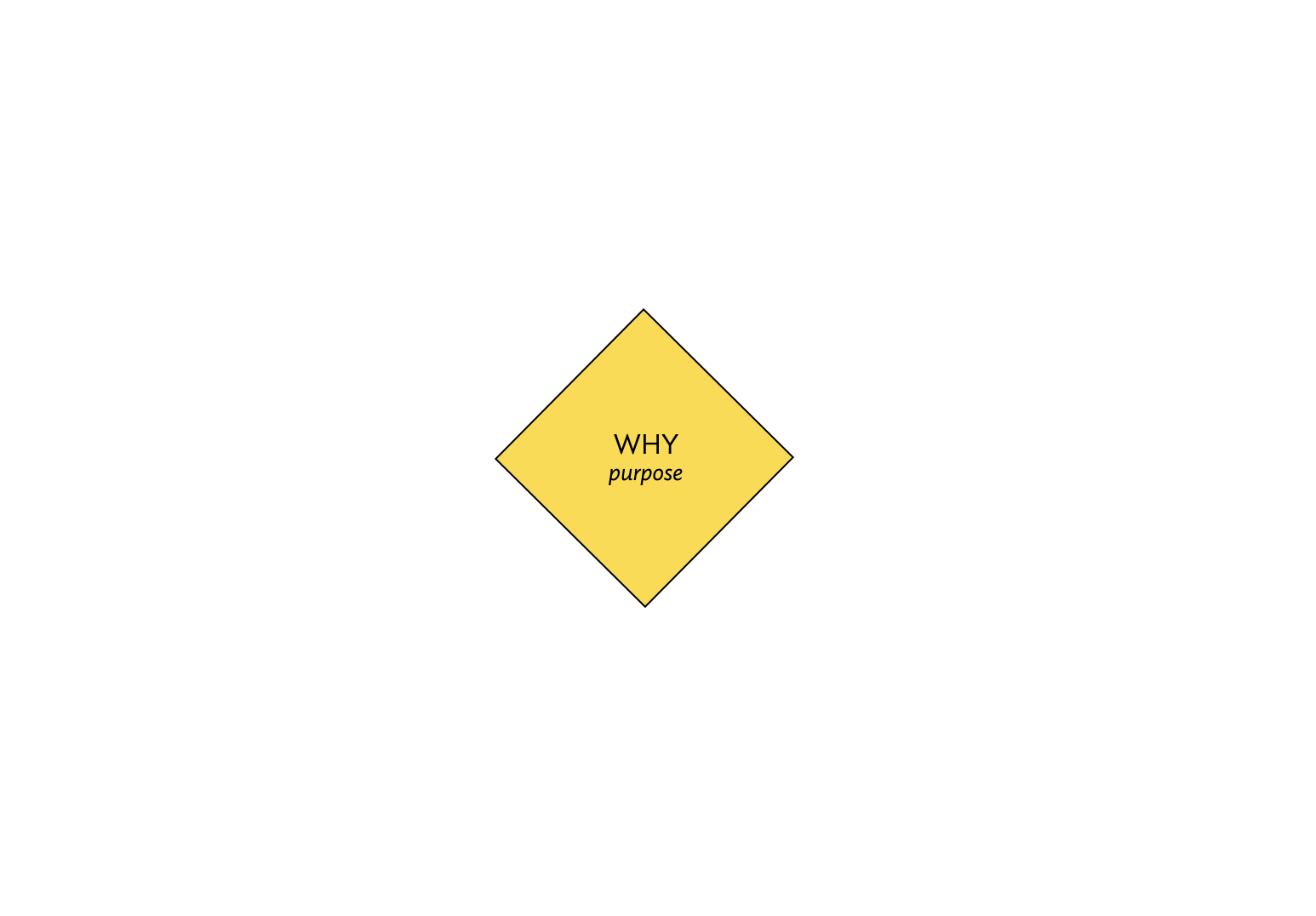
So. Let’s start at the beginning, with WHY.
Thanks to Simon Sinek, the phrase “start with why” is probably ingrained at a subconscious level in every leader’s brain, and Leadership Fluency is no exception. For a business to exist, it is essential to know its purpose, the role it will play in the world, and the future it aims to bring into existence.
Now we add four additional dimensions that build on the WHY: WHO, WHERE, WHAT, and HOW. All five of these dimensions are essential to define for the success of any business. They bring clarity, direction, coordination, and focus.
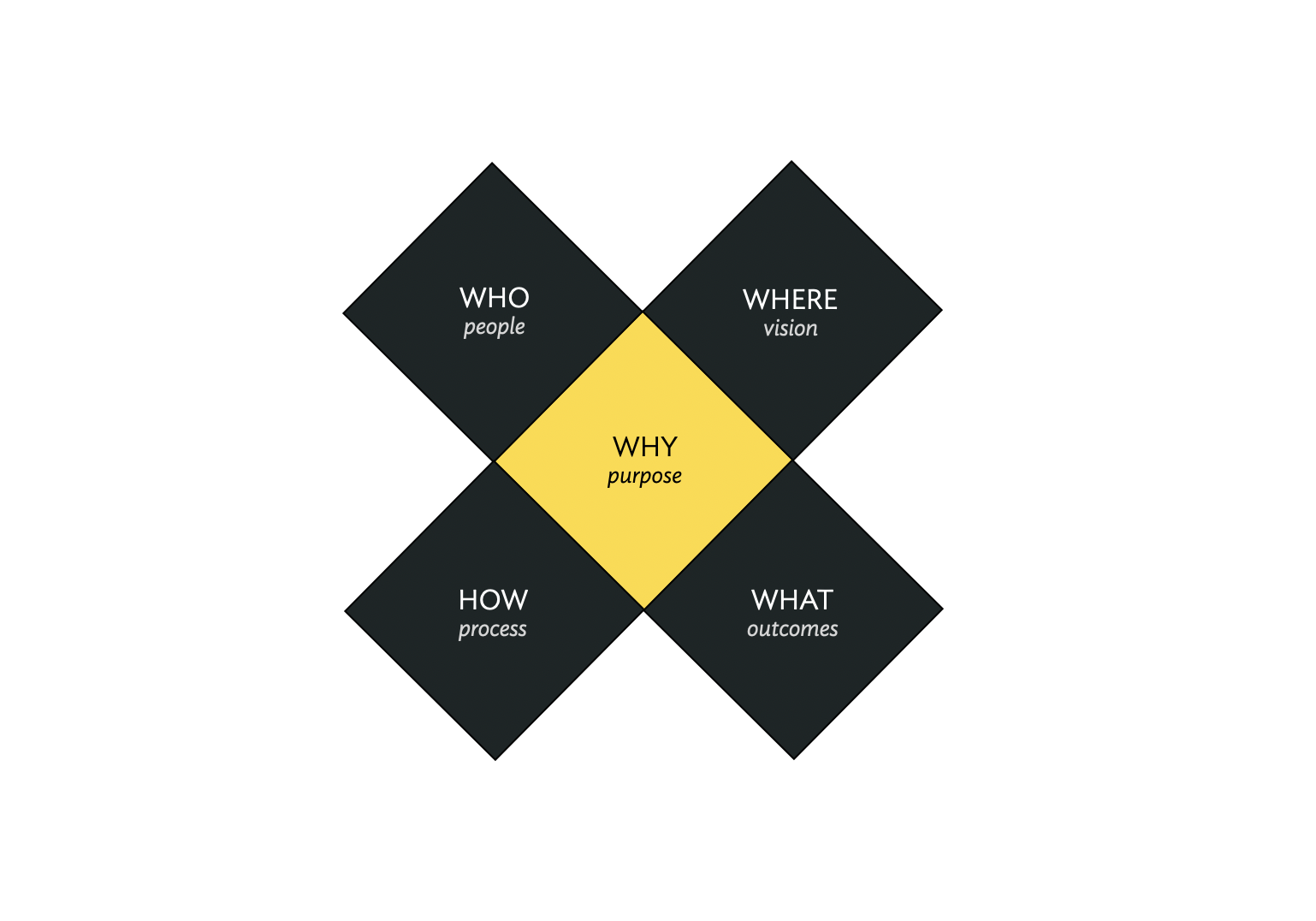
WHO is the dimension that represents the people critical to the success of the business—employees, customers, users, partners, investors, the board.
WHERE is about the vision, and works to answer the question, “where are we going and what does the world look like when we get there?”
WHAT are the outcomes that mark progress towards the vision. The milestones and goals we need to achieve along the way that will bring the vision closer to reality.
HOW are the processes and ways of working that encode decisions and create the reliability and structure to deliver consistent business outcomes.
When it comes to leadership, I’ve noticed a tendency to conflate a role with a specific dimension of the business. What this looks like in practice is that the role of “manager” is responsible for the processes that allow work to happen, “director” handles the decision making that sets priorities, while “executive” works at the level of vision.
This obscures something that is absolutely critical for every leader to understand: that leadership, whatever your seniority, consists of four distinct roles: leading, directing, managing, and coaching.
It is this conflation between business dimensions and leadership roles that can make AI feel so threatening. As AI is integrated into organizations it plays well in the business dimensions—vision, decisions, processes, and people—it can analyze and refine purpose, model vision scenarios to support decision making, optimize and implement processes, and bring clarity to career progression and performance.
But if the roles aren’t directly correlated with dimensions of the business, then what are they?
They are ways in which leaders enact and embody connections between business dimensions.
The Four Roles of Leadership
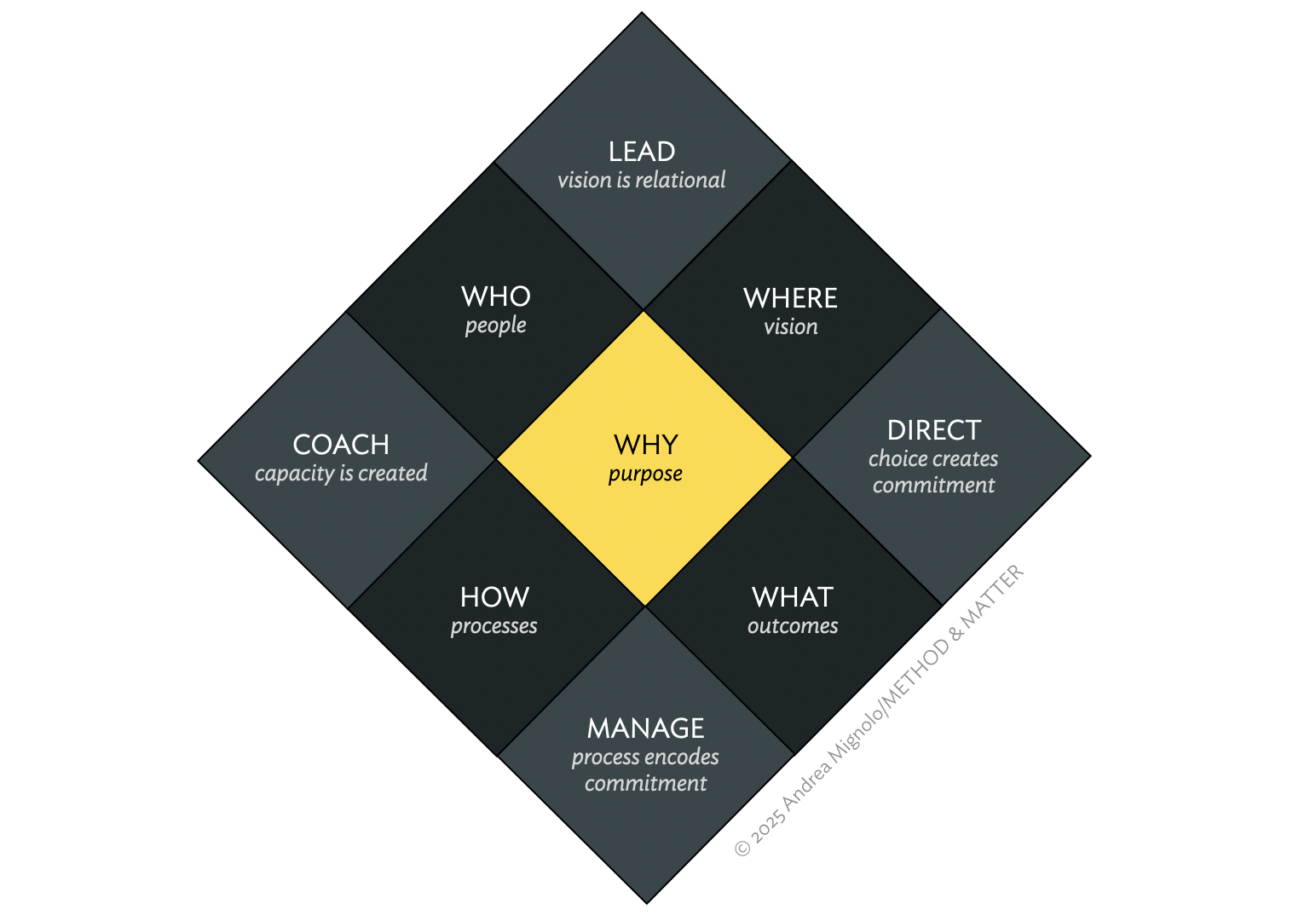
Let’s look at this role by role:
Leading
Leading connects the business dimensions of WHERE and WHO. It is the work of communicating the vision with enough purpose and clarity that others want to come along. Without enrollment, vision is just a destination that nobody is moving toward.
Leading makes vision a shared reality across the full ecosystem of stakeholders, translating it for different audiences and creating alignment, making it a deeply relational practice.
Directing
Directing connects the dimensions of WHERE and WHAT and is responsible for the contextual interpretation of vision.
Vision on its own is simply a statement of direction. And outcomes on their own, without the connection to vision, may work well for the team or department making them, but run the risk of running counter to business goals.
In order to make vision actionable, the act of directing must do the work to interpret the vision asking, “what does this mean for us here, now, at this particular moment in time?” The answer to that question becomes the decisions, commitments, and priorities that create the container for the team’s work.
Managing
Managing connects WHAT and HOW and creates the conditions in which decisions are enacted. What this reveals is that decisions become real through the environment that facilitates actual work. Managing encodes the commitments made through directing into repeatable, reliable structures that deliver results.
Coaching
Coaching is the relational side of managing, connecting the HOW and the WHO.
Until recently, coaching was bundled into the role of managing, with folks like Henry Mintzberg describing management as the interpersonal communication through which things get done.
The problem with this is that, without an explicit coaching role, people apply the activities of managing to people, treating them as variables to be optimized rather than human beings with interiority, developmental edges, and meaning-making capacity. Within this framework, we can now see that coaching is an explicit role, separate from the act of managing, that addresses gaps between the conditions in which work is achieved and people’s capacity to meet those conditions.
All four roles together
The practice of leadership is the mastery of these four roles which exist in the connection between various dimensions of the business. AI can handle many aspects within a dimension, but is not well-suited for the work that lives in the connective roles—this work requires human-led ownership, accountability, and judgement.
Leadership + AI
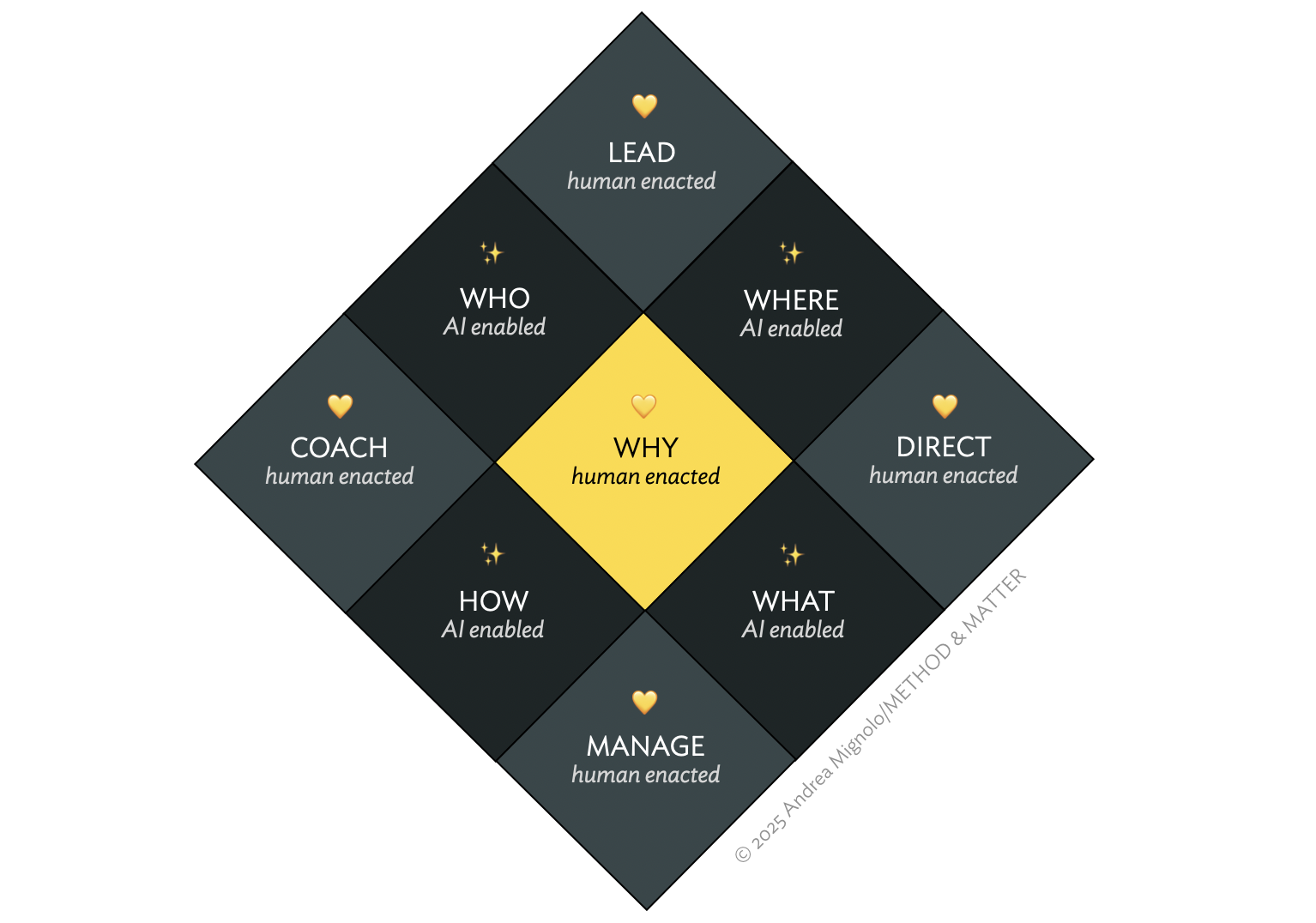
It’s important for leaders to be clear about how and where they are integrating AI, and what remains within their own leadership purview.
Leading + AI
AI can be integrated to bring refinement to the vision and to develop communication strategies, but the enrollment of people in a vision is a distinctly human act. Through storytelling and meaning-making, leading helps people understand the purpose and vision of an organization, along with how they fit into the bigger picture, what their efforts would do to bring that future to life. AI can support the refinement of a vision’s message for different audiences, but the actual transmission of the vision still lives in the domain of human relationships.
Directing + AI
If directing is the contextual interpretation of vision, then we already see the importance of human judgement and understanding in this role. AI can do a lot in the business dimension of WHAT, with its ability to generate options, model scenarios, surface trade-offs, and recommend priorities, but it can’t do the work of directing—of choosing and owning the specific interpretation, decisions, and commitments that create the container for what needs to happen to achieve the vision.
Managing + AI
Managing creates the conditions through which decisions become real and enacted. AI has a clear role to play here when it comes to tracking, measuring, reporting, coordinating, scheduling, monitoring, etc.
This means the role of managing, enacted by humans, shifts from overseeing processes to focusing on whether or not current conditions are encoding the right decisions. This is where a lot of change management fails—the decisions get made but processes stay the same, retaining old organizational memory when new ones are required.
Coaching + AI
AI is useful in identifying performance patterns, supporting people to reflect on their own work, tracking progress and staying in alignment with goals and milestones. But to fully develop capacity, to help someone identify blind spots, grow into opportunities, and fulfill their full potential, human presence is required. This is especially true in times of rapid change and great uncertainty where the stress of the unknown impacts us most acutely. Developing the capacity to be with uncertainty, to stay grounded and think clearly, to sense the way forward, is something humans do together.
AI can be used to enable various business dimensions with bounded, optimizable work, while the roles of leadership live in the interpretive, relational work between dimensions.
In a world where AI does (almost) everything, leading is in the connections, it is the work that requires human ownership, accountability, and judgement.
My hope in writing this is that these distinctions bring some clarity to leaders caught in the whirlwind of AI adoption and help them see the places AI is well suited for integration, and where things remain importantly human.
If this resonates with you, or if you have additional insights to share, I’d love to hear from you.
Be well,
Andi